Influencer Factory
With the rise of social media, fashion students are choosing influence over innovation, changing the industry’s creative landscape forever.
By Himanshi Moondhra
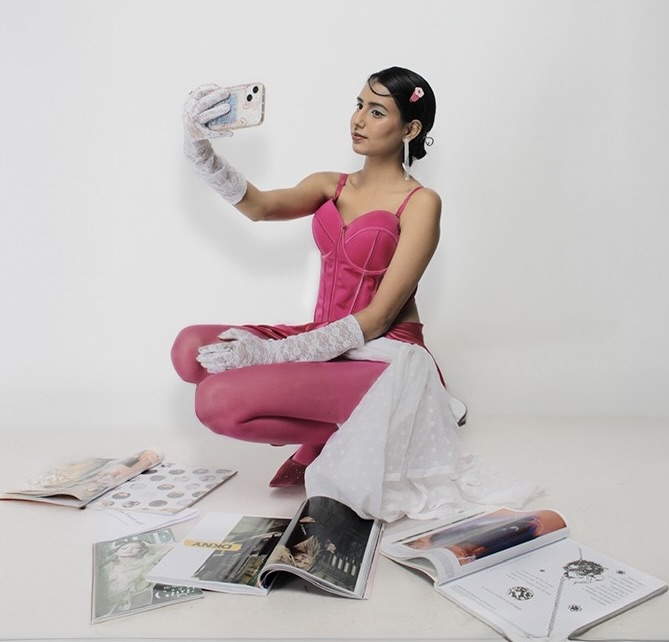
Model taking selfie surrounded by magazines instead of completing her assignments.
Fashion schools were once creative playgrounds, where students honed their craft, experimented with silhouettes, and pushed the boundaries of design. Today, they feel more like influencer boot camps. Sketchbooks have been replaced by ring lights, internships swapped for brand deals, and design portfolios overshadowed by Instagram grids. While the industry still needs designers and writers, schools are now churning out content creators faster than people who can stitch, construct, or critique.
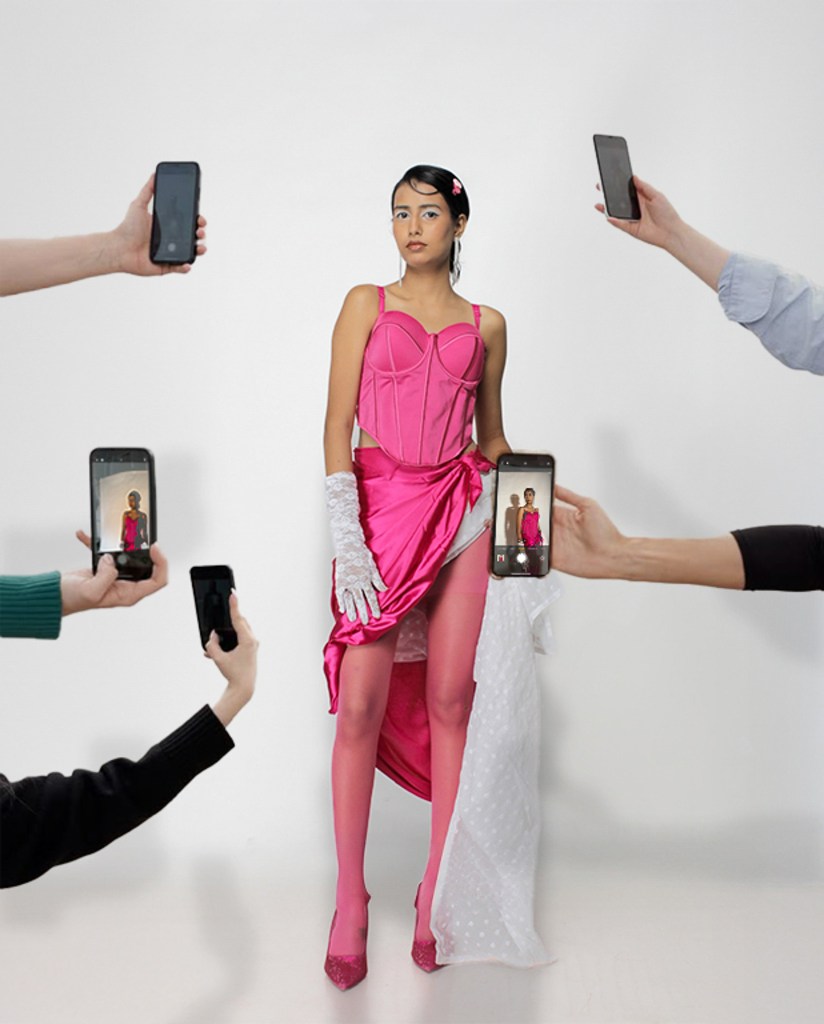
Photographer- Annie Boro, Models- Bhumi Gupta, Styling- Himanshi Moondhra, Hair-Paree, Makeup- Ishita Grover, Clothes Courtesy- Thrifted from Rajouri Garden, Location- Pearl Academy Studio, Creative Direction- Himanshi Moondhra
This shift isn’t accidental, but it’s the new reality. India’s influencer marketing sector is projected to grow by 25% in 2025, according to a report by EY and Collective Artists Network’s Big Bang Social. In 2022, the country already had 80 million digital creators, with estimates surpassing 100 million in 2023, as per marketing firm Zefmo. Many of them aren’t just hobbyists; they’re students who recognize that an online presence is often more lucrative than the traditional careers.
Inside classrooms, professors still teach the fundamentals of fashion and media, but outside, students see a different world. Success no longer comes from mastering construction techniques or crafting a well-researched critique, it comes from engagement rates, viral moments, and brand collaborations.
“My biggest assignment in college wasn’t a garment; it was a reel that took off,” says Mahika Sharma, a 22-year-old, final-year design student at Pearl Academy. She once dreamed of launching her own label, but when her behind-the-scenes content from a show hit 100,000 views, she saw where the real opportunities lay. “Why struggle to build a company,” she asks, “when you can just be the brand?”
Coutesy – Pinterest

This shift hasn’t gone unnoticed by professionals. Those journalists, who once shaped narratives through in-depth critiques, now find themselves navigating a landscape where digital personalities set the agenda. “A well-researched review once had the power to shape a designer’s career. Now, it’s social media buzz that does,” says Vanshika Gupta, a freelance journalist. Over the past few years, she has watched traditional reporting take a backseat to visually engaging, short-form content. “Long-form journalism isn’t dead, but it’s becoming niche. Brands care more about reach than research.” While she believes in the value of detailed storytelling, she acknowledges that today’s writers must balance credibility with digital relevance.
Still, not everyone is ready to trade pen and paper for likes. Some remain committed to traditional journalism, even if it’s a harder path. “Yes, social media gets you noticed faster, but I still love the depth that long-form writing offers,” says Rhea Malhotra, a 23-year-old fashion communication student from Indian Institute of Art and Design. She recognizes that the industry favours engagement over analysis but refuses to see traditional writing as obsolete. “It’s easy to feel pressured to adapt, but I’d rather write something meaningful than chase trends. There are still people who appreciate fashion beyond just aesthetics, people who want to read, not just scroll.”
This isn’t necessarily a downfall, it’s an evolution. In an age where digital presence often outweighs technical skill, industries are simply responding to demand. Priorities are shifting, and students are following suit. But whether through viral posts or in-depth critique, fashion’s conversation isn’t disappearing, it’s just being told in a different way.
 THIRDRAFT